Watch the existing habit
Before changing a room, notice how people already use its lights. Somebody may reach for the wall switch while carrying shopping, while another person uses a bedside lamp after the rest of the house is asleep. Those ordinary actions are the starting point. An app that works perfectly for its owner can still make the room less convenient for everyone else.
Smart bulbs need their electrical supply to remain available for wireless control. If the household naturally switches that supply off, the bulb may look disconnected in the app. Treat this as a control-design problem rather than user error. A small instruction on a switch might help temporarily, but it is a poor substitute for a convenient control in the expected place.
Provide a clear physical option
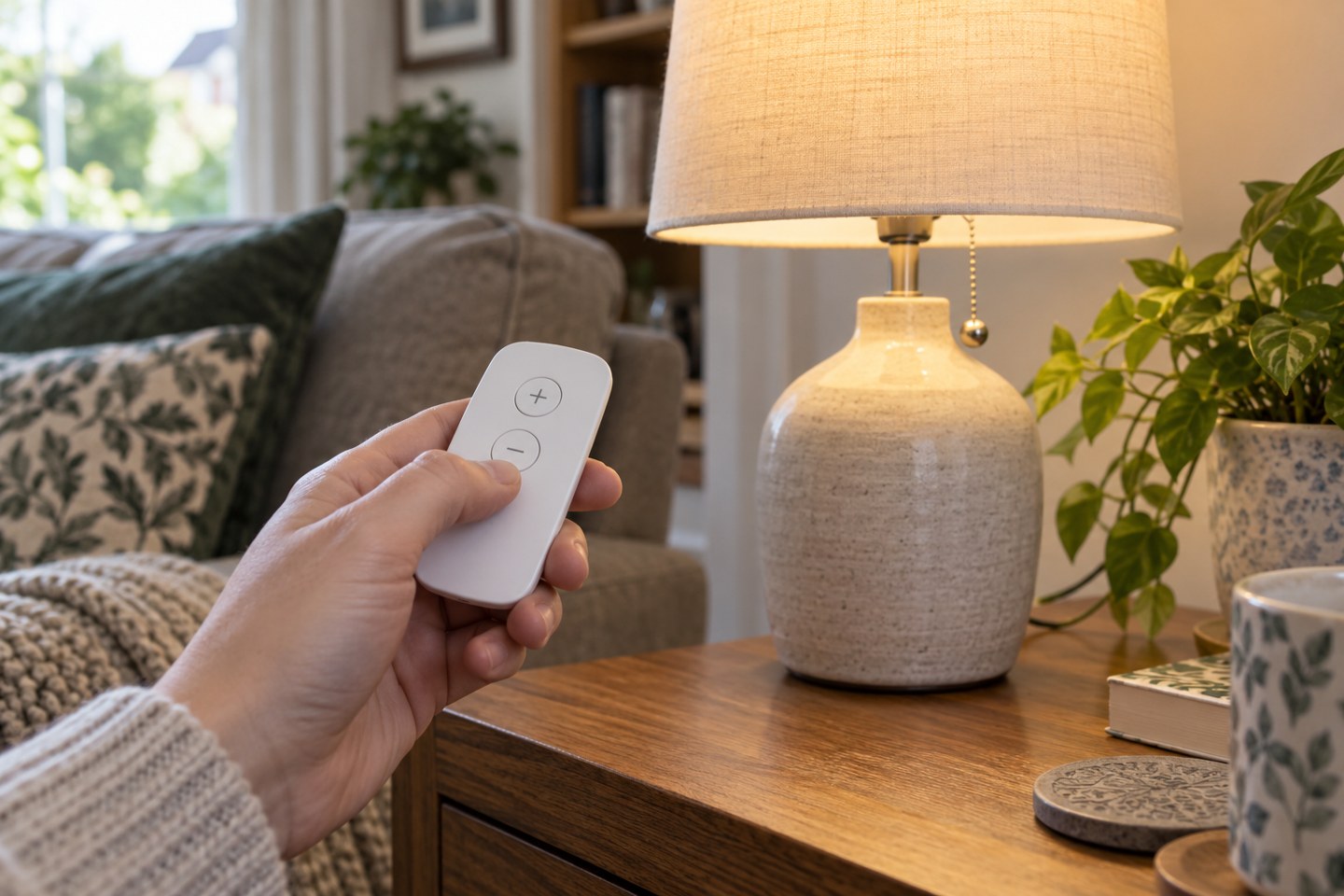
Look for a compatible wireless button or remote that offers the actions people actually need. Usually these are on, off and a comfortable brightness. Mount or place it where it is easy to find, using a method suitable for the surface and the product. Do not modify mains wiring as a shortcut to keeping a bulb powered; use an appropriate qualified installer for fixed electrical work.
Avoid making the everyday action depend on a long sequence of taps. If a remote has several gestures, make the simplest press perform the ordinary lighting task. A visitor should not have to learn that a double press means normal light while a single press starts a colour scene.
Name groups by the room or activity they control. A command for Living room should not unexpectedly switch off a landing light. Test names aloud if using voice control, particularly where two devices have similar names. Keep an individual lamp control available when someone needs light without illuminating the whole room.
Test the awkward moments
Try the controls with the phone elsewhere, with a guest, and after the light has been off for several hours. Ask somebody who did not configure the system to turn it on and adjust it. Their hesitation shows where the arrangement needs work more clearly than another successful test by the installer.
Check what happens after power is restored, following the product's documented behaviour. A lamp returning at full brightness may be harmless in a study and unwelcome beside a bed. If the model offers a restore-state setting, choose deliberately rather than assuming its default suits the room.
Keep routines subordinate to people
An automatic off time can be useful, but it should not repeatedly darken a room while somebody is still using it. Start with one modest schedule and agree how to override it. Test whether a later routine undoes the manual change, then simplify the rules if necessary.
Keep a brief household note with the control locations and how to recover ordinary lighting. This does not need to be a technical manual. The successful result is a room where people can get the light they want without thinking about the network behind it.